This is Paper A of the C03 note on night vision and infrared equipment - the monoculars, binocular goggles, weapon sights, fused goggles and clip-on thermal imagers that let an operator move, navigate and identify targets in low light and total darkness. It answers the first engineering question a battery supplier is asked: how does this equipment actually produce an image, what makes the two sensing principles different, and what electrical load does the cell or pack see across a night of use. It walks through the form factors in service, the image intensifier tube and its generations, the uncooled microbolometer used in thermal imaging, fused and clip-on designs, and the low-current power profile, then closes with an honest statement of where sealed nickel-metal-hydride fits. Paper B will convert this profile into cell count and capacity, and Paper C into the test and certification evidence. The numbers quoted are published manufacturer and service values used as illustrative anchors, and every worked figure is labelled as such rather than presented as a universal specification.
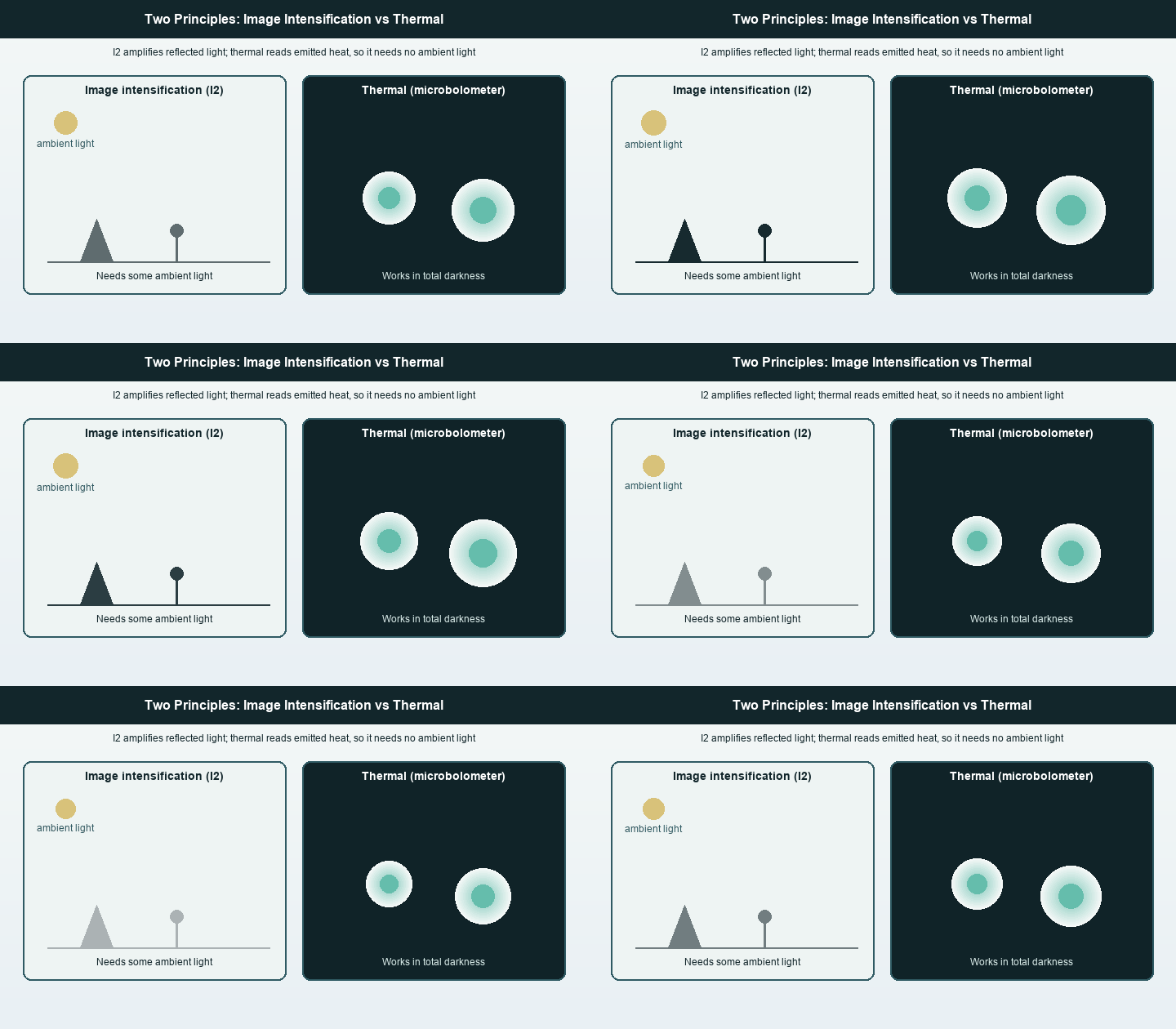
Key fact 1. Two different sensing principles are fielded, sometimes in the same housing. Image intensification (I2) amplifies the small amount of reflected visible and near-infrared light already present, while thermal imaging reads the long-wave infrared that every object emits as a function of its temperature and needs no ambient light at all. The equipment spans helmet monoculars such as the AN/PVS-14, binocular goggles such as the AN/PVS-31, fused goggles such as the AN/PSQ-20 family, weapon sights and clip-on thermal imagers that add a heat overlay to an existing I2 view.
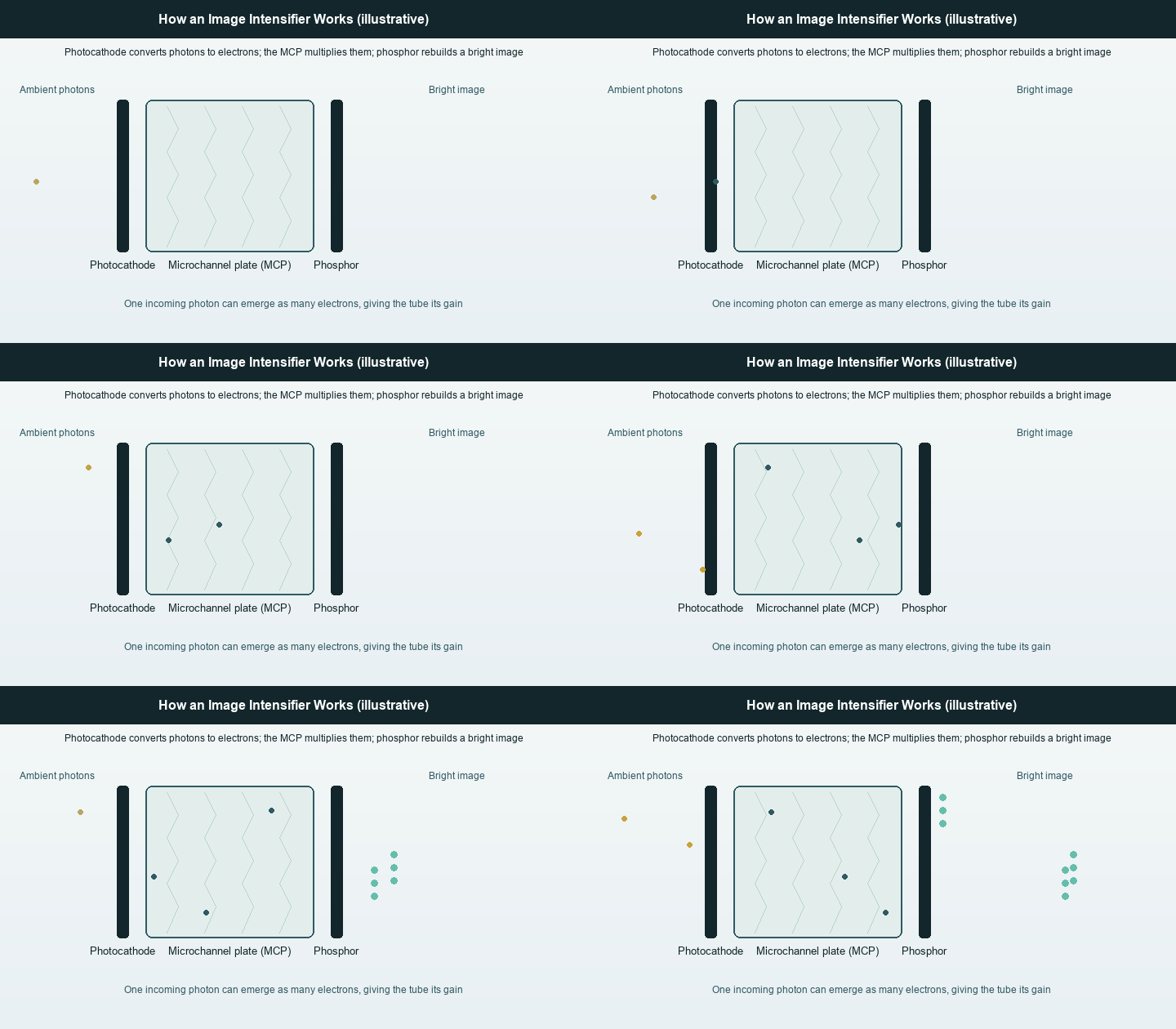
Key fact 2. The image intensifier tube is a three-stage vacuum device. A photocathode converts incoming photons to electrons, a microchannel plate multiplies those electrons through millions of microscopic channels, and a phosphor screen converts the amplified electron pattern back into visible light. The phosphor sets the image colour, with P20 the standard green and P45 the white phosphor many operators prefer. A high-voltage power supply drives the tube, and reference designs cite a working voltage on the order of 13.5 kilovolts even though the current drawn is small.
Key fact 3. Thermal cameras use a different detector. Uncooled cameras centre on a microbolometer, an array of tiny vanadium-oxide or amorphous-silicon resistors whose resistance changes as focused heat warms them; they need no cryogenic cooling and are smaller, lighter and lower power. Cooled cameras add a cryogenic cooler and detectors such as mercury cadmium telluride to reach higher sensitivity and longer range, at the cost of size, cost, power and a cool-down time. The fused ENVG couples its I2 tube with a 320 x 240 microbolometer.
Key fact 4. The analog I2 load is low current, but the illuminator and the digital option change it. A reference goggle (Newcon Optik NVS 7-3XT) lists maximum current of 25 mA and battery life over 80 hours without the IR illuminator versus over 30 hours with it; the built-in illuminator can draw as much as the tube. Representative military devices run on AA cells, with primary lithium AA favoured for cold and shelf life. Digital sensor-and-display night vision is a separate, higher load class in the rough range of 2-6 W.
Key fact 5. The battery ecosystem is mixed and the chemistry scope is honest. Frontline US night vision is designed around AA cells, with primary lithium (Li-FeS2) the common choice for extreme cold and long storage, while rechargeable sealed NiMH AA cells are practical for training, garrison and repeated-use logistics. Sealed NiMH runs at a flat 1.2 V, is tolerant of abuse, and is qualified to IEC 61951-2 and IEC 62133-1, shipping under UN 3496 with the not-restricted air path under IATA special provision A199. An honest scope statement does not claim it outperforms primary lithium in the coldest missions.
Night vision equipment is built around the way an image is delivered to the eye rather than the way a radio delivers a signal, so the form factors follow where the optics sit. A monocular such as the AN/PVS-14 is a single-tube handheld unit that also mounts on a helmet or adapts behind a weapon optic, while a binocular goggle such as the AN/PVS-31 uses two tubes for depth perception and folds its pods up when not in use. Weapon sights sit on the rifle, clip-on thermal imagers attach in front of an existing sight or goggle, and fused goggles merge both principles into one view. Helmet mounting uses a dovetail interface with a breakaway mechanism so the mount releases under load rather than injuring the neck, and procurement guidance calls for tube thresholds, mount safety and environmental qualification rather than a single headline figure.
The reason for this variety is that the two principles answer different problems. Image intensification preserves fine detail and the natural geometry of the scene as long as a little light exists, but it has nothing to amplify in a lightless cellar or cave and can be blinded by bright sources. Thermal imaging sees the heat a person or engine throws off regardless of light and penetrates light smoke and some obscurants, but it renders warmth rather than the crisp reflected detail the eye is used to. Fused and clip-on designs exist so the operator does not have to choose between the two.
The image intensifier is an evacuated optoelectronic tube with three core stages working in line. The photocathode at the input is negatively biased and releases electrons when incoming photons strike it through the photoelectric effect. Those electrons are accelerated toward the microchannel plate, a glass disk perforated by millions of microscopic channels; as an electron enters a channel and strikes the wall it releases more electrons, and the cascade repeats so a single electron can emerge as a great many. The amplified electron pattern then reaches the phosphor screen, where each electron excites the phosphor and the screen reconstructs the image in visible light, spatially matched to the original scene. The green image most people associate with night vision comes from the P20 phosphor, while P45 white phosphor gives a grey-white image that many find easier to read and faster to transition away from.
Tubes are loosely grouped by generation, and the labels describe real architectural changes even though they are not a single universal metric. Generation 1 devices have no microchannel plate and suffer distortion and blooming. Generation 2 adds the MCP and uses a multi-alkali photocathode, with reference tubes around 40-45 lp/mm resolution and signal-to-noise ratios roughly 14-18; they operate passively and resist blooming far better. Generation 3 keeps the same layout but moves to a gallium-arsenide (GaAs/GaAsP) photocathode, more sensitive particularly in the 800-900 nm band, and adds a thin aluminium-oxide ion-barrier film on the MCP to protect the photocathode from ions and gases. Autogating, used on modern tubes, rapidly switches the photocathode voltage so the tube is effectively pulsed at high rate, cutting average duty cycle and improving behaviour in bright and changing light. Chinese academic work has separately examined how low-light devices should be classified, which is a useful reminder that the generation framework is a convention rather than a physics law.
Every object emits infrared radiation roughly in proportion to its temperature, and a thermal camera focuses that energy onto a detector array instead of depending on reflected light. In an uncooled camera the detector is a microbolometer: each pixel is a tiny vanadium-oxide or amorphous-silicon resistor with a large temperature coefficient, mounted on a thermally isolated element so the focused heat changes its temperature and therefore its resistance, which the readout electronics turn into an image. Because the detector works at ambient temperature there is no cryogenic engine, and uncooled cameras are smaller, lighter, cheaper and lower power, which is why they dominate handheld and clip-on equipment.
Cooled cameras take a different route. A cryogenic cooler drops the detector temperature to reduce thermal noise, and the detector elements, commonly mercury cadmium telluride, become sensitive to very small differences in incoming radiation. That buys longer range and subtler contrast for demanding targets, but the cooler adds size, cost and power and the camera must wait through a cool-down period before it performs. The two are chosen against the mission rather than ranked in the abstract. A practical middle ground is the fused design: the ENVG pairs its image tube with a 320 x 240 microbolometer so the heat overlay is available without the bulk of a full cooled sensor.
Fusion puts both principles in one field of view. The AN/PSQ-20 Enhanced Night Vision Goggle was the first production goggle to fuse I2 and IR through an optical overlay, so the operator keeps the detail of the intensifier while heat signatures stand out in darkness, smoke and obscurants. Rather than force every operator to replace an existing goggle, the clip-on approach treats thermal as a module: a COTI or E-COTI clips onto the objective housing of an existing night vision device and adds a long-wave infrared overlay, with low-power electronics and a bracket that avoids refitting the helmet. The current ENVG-B extends the idea in a binocular, white-phosphor form that can also connect wirelessly to a rifle-mounted thermal sight. In each case the architecture is the same engineering judgement: intensifier detail by default, heat information added where the mission needs it.
The analog image intensifier is, first of all, a low-current load. The high-voltage power supply steps the battery voltage up to the tube's working level, on the order of 13.5 kV in reference designs, but the tube current itself is small. The NVS 7-3XT reference puts a number on it, with maximum current of 25 mA at 2.8 plus or minus 0.8 V and battery life over 80 hours without the IR illuminator versus over 30 hours with it. The illuminator is the variable that catches planners: in field use it can draw as much as or more than the tube, and a device rated around 40 hours with the illuminator off may give only 12-15 hours with it on full power. Low-battery warnings are calibrated to the battery, not the tube - the PVS-7 manual cites a blink at 2.4 VDC with roughly 30 minutes left, and the PVS-14E manual cites 1.2 VDC with the same rough reserve.
| Device | Battery | Published runtime / load |
|---|---|---|
| AN/PVS-14 monocular | One AA | About 50 h (ATN/Armasight); 60 h alkaline at 23 C (Elbit); about 339 g |
| AN/PVS-31A goggle | One AA lithium (4-cell pack optional) | At least 8 h on one AA; about 16 h average with the 4-cell pack; under 450 g |
| AN/PSQ-20 ENVG | Four AA lithium | 7.5 h fusion plus 7.5 h I2-only; 320 x 240 microbolometer; about 2 lb |
| NVS 7-3XT goggle | 2.8 V nominal | Max 25 mA; over 80 h without IR, over 30 h with IR |
| Digital night vision | Internal cell / USB power | Roughly 2-6 W depending on display, recording, Wi-Fi and IR |
Digital night vision is a genuinely different load. Where an analog tube only needs a high-voltage supply at low current, a digital device adds a sensor, a display, image processing and often recording and wireless connectivity, so planning figures run roughly 2-6 W and shift with screen brightness, video capture, app connection and cold weather. The two should not be compared on the same battery-life basis even though they look similar in the hand.
When ambient light is too weak even for an intensifier, the built-in illuminator projects near-infrared light that the tube can see but the unaided eye treats as invisible. The two common wavelengths trade stealth against sensitivity. At 850 nm, silicon sensors respond roughly twice as strongly as at 940 nm, giving a brighter image and about 30-50 percent more effective range at equal power, but the emitter sits close enough to the visible band that it shows a faint red glow up close in the dark. A 940 nm emitter is fully invisible with no glow, but sensors respond less and the range is shorter. The choice is made against how close an observer is likely to be and how much range the mission needs, and it has a direct effect on runtime because the illuminator is a major draw.
The single number most often used to grade a tube is the figure of merit, and it is a simple product: FOM equals resolution in line pairs per millimetre multiplied by the signal-to-noise ratio. A tube resolving 64 lp/mm at an SNR of 25 has a FOM of 1600. Resolution measures the finest detail the tube can reproduce, while SNR measures how clean that detail sits against the scintillation and noise in the image. Because the same FOM can be built from different pairs - high resolution at modest SNR or the reverse - careful procurement documents set a minimum FOM and a minimum SNR separately rather than relying on FOM alone, and they treat the figure as a grading and comparison tool rather than a guarantee of the whole viewing experience.
Sealed nickel-metal-hydride has a real place in night vision logistics, stated plainly rather than inflated. The frontline devices are designed around AA cells, and the primary lithium (Li-FeS2) AA is the common choice where storage and extreme cold matter, with manufacturer ratings extending roughly from -40 C to 60 C and a long shelf life. Rechargeable sealed NiMH AA cells run at a flat 1.2 V, are tolerant of overcharge and handling, and remove the cost and waste of disposable cells in repeated use. The honest limit is temperature: reference material rates NiMH to about -20 C and notes faster capacity loss in severe cold and self-discharge on storage, so it is not presented as outperforming primary lithium in the coldest frontline missions.
The realistic niches for sealed NiMH are therefore training and garrison goggles, depot and repeated-use scenarios, multi-bay charging logistics, remote and multi-cell battery packs and night-vision accessories where the buyer wants rechargeable, lower-cost power rather than disposable primary lithium. The chemistry is qualified to IEC 61951-2 for performance and IEC 62133-1 for safety, ships under UN 3496 and is treated as not restricted for air freight under IATA special provision A199, and the cadmium-free construction keeps it practical where NiCd packs are being retired. Weijiang manufactures sealed NiMH cells and assembled packs; it does not manufacture NiCd or lithium-ion cells, and any lithium work is pack assembly rather than cell production.
Night vision (image intensification) amplifies the weak reflected visible and near-infrared light already present and needs at least some ambient light, while thermal imaging detects the long-wave infrared that objects emit as heat and works in total darkness. I2 gives finer reflected detail, thermal shows heat signatures and works through light obscurants, and fused or clip-on devices combine the two rather than forcing a choice.
Through three stages. The photocathode turns photons into electrons, the microchannel plate multiplies each electron into many through a cascade in its microscopic channels, and the phosphor screen converts the amplified electron pattern back into visible light. The high-voltage supply drives the process at a working voltage on the order of 13.5 kV while the current stays small.
Because it is a major draw, often as much as the tube itself. A reference goggle lasts over 80 hours without the illuminator but just over 30 hours with it, and field guidance shows a device rated around 40 hours without IR can fall to 12-15 hours with it on full power. The wavelength choice, 850 nm for range or 940 nm for stealth, also affects the power and range trade.
Because the AA form factor is universal and primary lithium handles extreme cold and long storage well, with ratings roughly from -40 C to 60 C and a light weight. Rechargeable NiMH is a practical alternative for training and garrison use where recharge logistics and repeated use matter more than the coldest operating edge.
The figure of merit is resolution in lp/mm multiplied by the signal-to-noise ratio, so a 64 lp/mm tube at SNR 25 has a FOM of 1600. It compresses the two most important image qualities into one grade for comparison and procurement, but careful buyers set separate FOM and SNR floors because the same FOM can come from different resolution and SNR pairs.
UN 3496 is the surface-transport entry for nickel-metal-hydride batteries, and IATA special provision A199 lets properly prepared NiMH ship by air as not restricted. The treatment differs from the lithium battery rules, which is one logistics advantage of nickel chemistry, and the UN number itself is not used on the air waybill description.
Principle and device references: the image intensifier description draws on manufacturer technical material and IEEE/technical references, the generation and gating discussion on academic reviews of night vision technology and published technical FAQs, and the thermal section on Teledyne FLIR technical material and academic work on uncooled detectors. Device characteristics for the AN/PVS-14, AN/PVS-31, AN/PSQ-20 family and NVS 7-3XT come from manufacturer datasheets, brochures and operation manuals, and the clip-on and fused material from ENVG and E-COTI datasheets and service reporting.
Cell, pack and transport references: the current and battery-life anchors come from the published datasheets and manuals used as illustrative anchors rather than universal specifications, and the digital 2-6 W range from technical planning references. Nickel cells and packs are qualified to IEC 61951-2 and IEC 62133-1 and ship under UN 3496, with IATA special provision A199 defining the not-restricted air path; environmental qualification follows MIL-STD-810 and MIL-STD-461, with device-level performance specifications such as MIL-PRF-49324 and MIL-PRF-49427. No statistics have been invented, and the chemistry scope reflects fielded practice rather than a claim that one chemistry replaces every other.
Weijiang Power supplies sealed NiMH cells and assembled NiMH packs for training, garrison and night-vision accessories and remote battery packs, built to the device's geometry and retention requirements with pack-level protection. The cells are qualified to IEC 61951-2 and IEC 62133-1 and the packs ship under UN 3496 with the not-restricted air path under IATA A199. Send us your device model, nominal voltage, whether it uses an intensifier, thermal or digital sensor, illuminator wavelength, expected temperature and charging arrangement, and we will work through the cell count, capacity and current design and support the evidence for your evaluation. See the Weijiang NiMH product range for standard pack formats, or contact our OEM team with the device specification and load profile.


